Friday, September 14, 2012

REMEMBERING PETE GUERRERO 1917-2012


My son, John, was an avid watcher of Sesame Street during the 1970s so when Edgar Tafel's Apprentice to Genius: Years with Frank Lloyd Wright was published in 1979 the photograph of Wright by Pedro Guerrero on the back cover of the dust jacket (see below) immediately caught his attention: "Dad, he looks like Dracula!" (a reference to the Sesame Street character Count Dracula).  Shortly after the book came out Edgar Tafel, a former Wright apprentice, was in town for a meeting at the Martin House and asked me to drive him to the Buffalo airport to pick up Pete Guerrero who had been commissioned to photograph a set of Wright drawings belonging to architect-collector, Jack Randall. Once Pete was in the car the conversation quickly turned to Tafel's new book. Pete: "I see you used the Dracula shot for the back cover." (!)  Tafel (chuckling):  "Of course!"   John was vindicated.


Frank Lloyd Wright, the Dracula Shot
Pete Guerrero was known throughout Wright circles an extraordinarily kind man. When I was preparing an article on Wright and photography in the 1980s Pete took a train from New Canaan, Connecticut, into Manhattan on a Saturday morning, talked to me for several hours about his experiences with Wright -- a treasury of insights -- and promptly hopped a train and returned to New Canaan.
Me and Peter (photo by Eric Jackson-Forsberg)

Eric Jackson-Forsberg blogged here about Pete and Dixie's visit to the Martin House last year (see "Vote for Pedro" August 30, 2011). For a comprehensive obituary Pedro Guerrero, Who Captured Art in Photos, Dies at 95 (N.Y. Times).

Our sympathy goes out to Dixie and the rest of the Guerrero family.

Wednesday, September 12, 2012

It Ain't Me (Babe)

Dear Wright-up readers:

Please note that the estimable Jack Quinan has assumed the role of Editor-in-Chief of the Weekly Wright-up, but for reasons unknown, those who receive email reminders still see my name attached to them.  This is causing a good deal of confusion, so I thought I'd check in just to say that, even if you get an email that appears to be from me, the information it contains pertains to Jack.  Kudos to him for his foray in to the blogosphere, and for his new book!

Eric Jackson-Forsberg

A NEW BOOK AND AN OLD FRIEND

John C. Courtin
Board members, colleagues, staff, and friends gathered at the Martin House on September 4 to bid farewell to John C. Courtin, who more than any other individual, in his capacity as Executive Director of the Martin House Restoration Corporation, brought the six-building Martin House complex to its present state of restoration and reconstruction. Through an enviable combination of keen, absorptive intelligence, endless energy for work, and an ever cheerful demeanor, John has had an indelible impact on the city of Buffalo. We will miss him and Sharon, his wife.


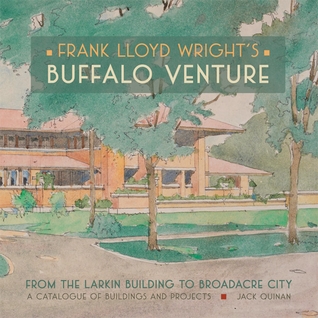
Pomegranate Communications, Inc. in San Francisco has just released my book, Frank Lloyd Wright's Buffalo Venture: From the Larkin Building to Broadacre City. Following monographic studies of Wright's Larkin Administration Building (1987) and Frank Lloyd Wright's Darwin Martin House (2004) I decided to write an essay and catalogue all  twenty-four of the buildings and projects that resulted from Frank Lloyd Wright's involvement with his Buffalo clients between 1903 and 1935. The project resulted in an exhibition at the UB Anderson Gallery in Buffalo in 2009 timed to coincide with the Annual Meeting of the Frank Lloyd Wright Building Conservancy in Buffalo. I am pleased with Pomegranate's fine production and I would like to thank all of those many people who helped to make it possible.

Wednesday, September 5, 2012

"HOW TO LIVE IN THE DESERT"

Anyone who cares a whit about Frank Lloyd Wright should jump at the chance to sign the petition (14,000 and rising) [google: Petition/ CITY OF PHOENIX: Save the David and Gladys Wright House],from destruction. The house is a dazzling performance from those later years when Wright engaged the vexatious form of the spiral, but it also represents a touching gesture to a son from a father who wrote in his autobiography: "The architect absorbed the father in me... Is it a quality? Fatherhood? If so, I seemed born without it. And yet a building was a child. I have had the father-feeling, I am sure, when coming back after a long time to one of my buildings.That must be the true feeling of fatherhood. But I never had it for my children."

Pedro (Pete) Guerrero, Wright's personal photographer, tells of going to David Wright's house with Wright to photograph it for House Beautiful magazine in 1955. Apparently they were not then welcome inside the house so Pete set up his camera at the edge of the property. Wright decided, however, that the shot would look better if some of the vines above the living room were adjusted, so he scampered up onto the roof (never mind that he was 88) to fix them. From a chair in the living room David noticed that the shaking vines and went out and -- according to Pete -- threw his father off the property. There must be more to this story.
The David and Gladys Wright House
Wright and Pedro Guerrero c1955

Wright lived to be 91, David Wright died at 104, and Pete Guerrero is still going strong in his nineties. Surely the house will endure if you help.

Friday, August 24, 2012

MORE ON THE MARTIN HOUSE LANDSCAPE

Walter Burley Griffin, Unidentified incinerator, Australia, c1930

My last blog, on the projected restoration of the Martin House landscape, brought a veritable deluge of information and some well-informed disagreement with my speculation that Wright may have fired Walter Burley Griffin because he (Wright) did not like Griffin’s floricycle. The fusillade (a shot heard around the world – literally) came from Christopher Vernon, Professor of landscape design at the University of Western Australia in Perth, and he should know. Currently at work on a book on Walter Burley Griffin, Chris is the author of numerous articles on the leading American landscape architects Griffin, Jens Jensen, and Wilhelm Miller, many of whom knew or worked for Frank Lloyd Wright at various times. In Chris’s estimation Griffin designed the Martin landscape, Wright approved of the design, and it should be the basis for any restoration. He points out that Griffin left Wright’s office primarily because he won the substantial commission to design the landscape for what is now Northern Illinois University at Dekalb in 1906.  Griffin was outgrowing his role in Wright’s office just as Wright had outgrown Louis Sullivan but he remains somewhat underappreciated in the United States because he left for Australia in 1912 where he, and his talented wife, Marion Mahoney Griffin, enjoyed splendid careers before moving on to India to work. Griffin’s Australian work begins in a Wrightian vein but is transformed in the 1920s  (see picture) into an exuberance reminiscent of Bruce Goff.  It turns out that Griffin took a substantial record of his work for Wright, including 1907 Fuermann photographs of the Martin, Barton, and Heath houses in Buffalo, a drawing of the Larkin Building, garden plans, and numerous photographs of his independent work in the United States, which now reside in the National Library of Australia. http://www.nla.gov.au/apps/cdview/?pi=nla.pic-vn3944294.
Christopher Vernon notes that Griffin returned to the United States for a visit in 1932 and made a special visit to the Martin House that he recorded photographically – additional proof that the landscape was largely his. Hopefully Christopher Vernon will also make a return visit.

Monday, August 13, 2012

THE MARTIN HOUSE LANDSCAPE


                                       The Martin House Landscape plan of 1910 (Wasmuth) 

Currently the Martin House is an architectural photographer’s dream, of sorts, in that the buildings reside on a veritable carpet of green grass (except for the northwest garden behind the house) and the elms and maples that once screened the property along Jewett and Summit avenues are long gone. The setting would be more appropriate to Le Corbusier’s Villa Savoie. Plans are underway, however, to restore the landscape, a task made formidable because of a jumble of evidence: four or five original drawings that are not consistent, numerous historic photographs not all dated, fragments of the original plantings, and letters referencing the purchase of certain plants. Then there is Wright’s elegant re-imagining of the entire plan for the Wasmuth portfolio in Berlin in 1910. (above) The largest and most carefully detailed plan, executed by Walter Burley Griffin while Wright was in Japan early in 1905, features an overwrought “floral hemicycle” consisting of 20,000 plants that were to arc around the east porch of the main house. This plan may be the reason that Wright fired Griffin later in 1905. So there are many questions to resolve: Do the early photographs reflect portions Griffin’s plan?  Since Griffin subsequently won the competition to design Canberra, the new capitol of Australia, does his plan merit special attention? Should Wright’s Wasmuth version of the plan be given consideration? These questions will be answered by a team of experts working with  the understanding that the landscape is of the utmost importance to Wright’s unifying vision.


On another matter, Wright’s home for his son, David, in Phoenix, -- named by the architect, “How to Live in the Southwest,” (above) is at risk of demolition.  For an online version of the press release see: www.savewright.org/index.php?t=news_focus&story_id=82 Or write mayor.stanton@phoenix.gov  and express your dismay at the possibility of losing this important building.


Monday, August 6, 2012

RECAPTURING THE MUSICAL WRIGHTS


In November 2011 David Patterson, a musicologist from Oak Park, Illinois, gave a wonderful keyboard accompanied presentation on the influence of classical music on Frank Lloyd Wright’s architecture in the Greatbatch Pavilion of the Darwin D. Martin House.  Wright makes it clear in his autobiography that an appreciation of music was the one great gift he received from his father, but it is a fleeting acknowledgment and the weight of significance in Wright’s formation, according to Wright, falls largely to his mother.
Nevertheless, Wright’s architecture is redolent with musicality and this is nowhere more evident than at Taliesin and Taliesin West where music was an essential part of daily life in the fellowship years (and it continues today in the Frank Lloyd Wright School of Architecture) and in Wisconsin Wright was known to broadcast Beethoven across the valley for the edification of local farmers. It appears that William Cary Wright’s impact on his son, once a mere footnote in history, is about to blossom into tangibility and significance: Through years of research David Patterson has located more than twenty pieces of music composed by Wright’s father and is seeking funding through the Kickstarter program to create the first ever recording of the music of William C. Wright.  If he succeeds we can all hear what Wrightheard his father creating during his childhood and historians and critics of music will be able to determine the quality of the work. If you are interested in helping David succeed