Saturday, January 19, 2013

1893, A YEAR TO REMEMBER


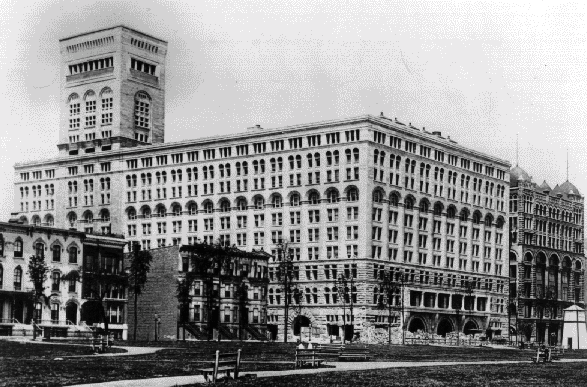
Adler & Sullivan, The Auditorium Building, Chicago, 1887

1893 was a year to remember: An economic depression known as the "Panic of 1893" had a devastating effect on American banks and businesses, and the Larkin Company in Buffalo was not spared.To make matters worse Elbert Hubbard informed his partner, John D. Larkin, that he would be leaving in January 1893 to attend Harvard, and demanded his share in the business. Larkin refused and law suits were threatened.  Darwin Martin, eager to take over Hubbard’s position, was told that it would involve no increase in salary. 1893 was also the year that Frank Lloyd Wright decided to leave Adler & Sullivan and open his own architectural practice in Chicago. Even the high point of the year in the United States was problematic: the much anticipated Chicago world's fair celebrating Columbus’s discovery of America in 1492, was delayed until 1893, but it was a smashing success nevertheless. Four million Americans visited the World’s Columbian Exposition, and Elbert Hubbard and Darwin Martin were among them.

Owing to his abrupt and untimely departure from the Larkin Company Hubbard and John Larkin were not on speaking terms but Hubbard was able to maintain an avid, vested interest in the fortunes of the Larkin Company through his friendly relationship with Darwin Martin.  Darwin Martin noted in his diary on the first of June, 1893, “I  [went] to East Aurora where I walked five miles with Mr. Hubbard and spent the night.” Shortly after that on June 22, 1893 Hubbard wrote Martin an enthusiastic account of his visit to "The Fair," as the World’s Columbian Exposition was known. The letter suggests that Hubbard was aware that the Martins, too, were going to the Fair. “I think five hours a day at the Fair will do one as much good as eight or ten. I spent eight days inside the gates and the extent of the exhibition is far beyond my expectations – far surpassing the Centennial [Philadelphia 1876].” Hubbard's stay at Harvard was obviously short lived.

Despite the slow-down at the Larkin Company the Martins embarked for the Fair in Chicago a few weeks after Hubbard's visit. Ever generous when it came to his family, Darwin fashioned the occasion into something of a reunion. Along with Isabelle Martin, his wife, and Nettie Reidpath, her sister, they were joined by Darwin’s brother William and his family (Chicagoans), his sister Delta and her husband George Barton (who were then also living in Chicago), Darwin’s oldest brother, Frank and his wife, Florence (wanderers), and Maude Martin, Darwin’s half-sister from Nebraska, whom he had not seen for fifteen years. Of her he had only this comment: "Little bit of a girl, lisps."
The Auditorium tower
But why the top of the Auditorium Building? Two possibilities presents themselves: first, the roof of the tower of the Auditorium Building, then one of the highest points in Chicago, was an ideal place from which to survey the city, and Chicago in 1893, home of the Chicago School of skyscraper pioneers, was something to behold. But they may also have been drawn to the Auditorium because its architects, Adler & Sullivan, were then building the Guaranty Building in Buffalo, soon to be recognized as the finest building in the city. At any rate, the rooftop moment places Darwin Martin immediately above the office of Adler & Sullivan where Frank Lloyd Wright was the principal draftsman. Martin and Wright would not meet, however, for another nine years when the Larkin Company executives invited Wright to Buffalo to discuss a new office building.


Thursday, January 10, 2013

WRIGHT AT WORK IN THE PRAIRIE YEARS


WRIGHT'S OAK PARK STUDIO  AS CONVERTED TO A LIVING ROOM AFTER 1911


WRIGHT'S STUDIO AS RESTORED IN THE 1980S 


Insights into Frank Lloyd Wright's working methods during the Prairie period (1900-1909) are rare and tend to materialize  in little bursts from time to time. Among the best of these is a group of letters written by Charles E. White, Jr., a draftsman who had come to Wright's Oak Park studio around 1903, to his former employer, W. R. B. Willcox, in Vermont. White describes Wright's unit system in detail, in text and sketches, and pays particular attention to the Darwin D. Martin House in Buffalo, which was then being designed. [The letters were edited by Nancy K. Morris Smith and published in the Journal of Architectural Education in the fall of 1971]. This passage is from White's letter to Willcox of November 16th 1903:

"He [Wright] is certainly an impractical man -- is way behind in his work, but calmly takes seven weeks to alter his office, and lets the work wait. The Buffalo drawings are not even completed, and they are hammering him all the time. Promised the Montreal sketches for November fourth, and hasn't even started to think about them! It makes me nervous to think of the way he treats his clients, and yet he seems to get the work all the time."

A similar passage appears in a letter from William E. Martin in Oak Park to his brother, Darwin, in Buffalo, May 20, 1904: 

"I called his office yesterday morning, and one of the draftsmen said that he had been working on the plans, and mailed them to you Thursday, but knew nothing about the brick. He said that when Mr. Wright returned from Buffalo, he threw the plans into the corner of the office, which, by the way, has been torn up from stem to stern for the last two weeks, -- and said nothing about any alterations..."

In Buffalo, Wright's erratic methods were subject to Darwin Martin's relentless" hammering," but C.E. White, jr., in the eye of the storm, got an answer from Wright himself and expressed it in a letter to Willcox of May 13th 1904: 

"The studio is again torn up by the annual repairs and alterations. Twice a year, Mr. W. rearranges and changes the different rooms. He says he has gotten more  education in experimenting on his own premises, than in any other way." 

Wright's penchant for experimentation never ended and is best seen at Taliesin, in Spring Green Wisconsin, Wright's home and studio, built, rebuilt, and continuously expanded from 1911 to his death in 1959. Taliesin is currently under restoration --a task of staggering complexity -- by Taliesin Preservation, Inc. 

Plan of Taliesin (The Frank Lloyd Wright Foundation)


Wednesday, January 2, 2013

DARWIN D. MARTIN, AUTODIDACT

Frank LLoyd Wright: Encyclopedia Britannica bookshelf for the Darwin D. Martin House (photo: New York State Bureau of Historic Sites)


In the early 1980s I sought out Everett K. Martin, Darwin Martin's nephew, at his home in Hyannisport, on Cape Cod where, over lunch, he recalled that during visits to his uncle Darwin's home in Buffalo Darwin would quiz him and the other children on a variety of topics. If they didn't have an answer he would direct them to the Encyclopedia Britannica for which Frank Lloyd Wright had designed a special shelf.


Detail of Wright's Encyclopedia Britannica bookshelf
During those same years I made several visits to the home of Dorothy (Martin) Foster at 95 Highland Avenue in Buffalo who told me that her father often took a volume of the Encyclopedia  Britannica to read as he traveled to work on the Belt Line.


Recently, while trying to organize my home office, I came across a single page of carbon-copied typescript. I don't know how I came into possession of it but it includes the following paragraph:

"I had a client once -- Darwin D. Martin -- he made the Larkin Company what it was when it was something; behind him on the table in the dining room was a big dictionary. After I had built the house, I was building other buildings and I used to dine there often, and this thing would come up and Mr. Martin would go over to that dictionary two or three times during a meal -- finding out. And he was a self-educated man; never went to college, didn't have much schooling: he was "the boy from Missouri [Valley]" that Elbert Hubbard wrote a piece about once. But his tireless, ceaseless curiosity concerning everything! And he became a remarkably educated man. He was a Christian Scientist, so far a religion went -- which was kind of a bar across his path -- but still he got somewhere; he was a religious man, and he was the man who had me do the Larkin building. So, the dictionary act is a thing I have inherited; I don't do it often enough. Every morning, we should have this dictionary behind here, because we are going to need it..." 

Tantalizing ! Who is this man? What more does he have to say in the rest of the manuscript? (This is from page 14) The line "after I built the house" would seem to indicate that this is an interview with Oscar Lang, contractor of the Martin House, but the line "the man who had me do the Larkin building" points elsewhere since Paul Mueller is generally credited as the principal supervisor of Wright's Larkin Administration Building. Given that Mueller was based in Chicago and was generally occupied with large urban buildings it is highly unlikely that he was building frequently in Buffalo. It is possible that the mysterious speaker, possibly Lang, was in charge of some part of the Larkin Building project, such as masonry or carpentry.  We may never know, but the collective  testimony of three people -- Dorothy Martin Foster, Everett K. Martin, and this builder who was a frequent visitor to the Martin house -- tells us that Darwin Martin's considerable success in life was driven by an insatiable quest for knowledge.


Friday, December 21, 2012

Christmas at the Martin House

On December 25, 1907, Darwin D. Martin wrote in his diary, Memorandum of Events in the Life of Darwin D. and Isabelle R. Martin, the following words:

A beautiful Christmas.  We sent and received many gifts--one from Belle [Isabelle Martin] to DDM [Darwin D. Martin] a lovely miniature of Darwin's.  As usual Grandma and Margaret out Christmas eve until 26th.  Grace Peckham also overnight Christmas eve, Christmas dinner guests were these, Mrs. Peckham, Mrs. Parmalee, and family.  To supper with these except Parmalee, also Moreys, Simpsons and their friends Mr. and Mrs. Austin of Ithaca.  Assets reach a million for first time. 

Here, Darwin D. Martin describes the familiar traditions we often associate with the holidays--the exchanging of gifts, the welcoming of house guests, and the hosting of dinner parties--and he concludes with the proud, yet factual, declaration of his newly-reached status as self-made millionaire.  Yet in reading this journal entry, one begins to wonder what more do we know about Christmases past in the Martin family household?


Martin Family Photographs, University at Buffalo Archives

An archival photograph sheds some light on the Martins' custom of decorating the family Christmas tree.  A tall, slender spruce rises to the height of the ceiling frieze rail and stands adjacent to the southeast pier cluster at the point where the living room and the library meet.  Clusters of multi-shaped glass ornaments and sparkling strips of silver tinsel adorn it, underneath which sits an overflowing pile of gifts--including what appears to be a large box "wrapped" in a plaid blanket--all awaiting to be opened.


Nellie Gardner and volunteer members of the Interior Beautification Committee trim the Martin House Christmas tree.


Taking inspiration from this historic snapshot, staff and volunteers have brought the yuletide spirit back into the Martin House through the temporary installation of a Christmas tree evocative of the one that was once trimmed by the Martins--right down to the very detail of using a period-appropriate tree stand by North Brothers Manufacturing Company, an early 20th century iron and brass foundry from Philadelphia, PA.

We hope you will come for a tour of the Martin House and discover it with your own eyes.  And until then, best wishes for a holiday season filled with much joy, peace and success--from our house to yours!


Wednesday, December 19, 2012

A TALE OF TWO EDGARS


1. Edgar Kaufmann, Jr.
2. Edgar Tafel (photo by Al Sabatini)


Edgar Kaufmann, Jr. never attended college, instead he studied painting in Europe and in 1933 joined Frank Lloyd Wright's Taliesin Fellowship for a year before returning to his family's department store business in Pittsburgh. Possessed of an exceptionally  keen eye for design, in 1940 Kaufmann became the head of the Department of Industrial Design at the Museum of Modern Art in New York. In that capacity one of his tasks was to locate and select objects for the Museum's collections. On May 20, 1947, while lecturing in Buffalo, he wrote to Frank Lloyd Wright about the status of Wright's Buffalo buildings, with an eye toward finding likely specimens. Following a discussion of the Larkin Building he wrote:

"I visited the Martin and Heath houses. The first is almost as shocking as the [Larkin] office building and parts of it are already being demolished. The furniture is not in the house. The Heath house is up for sale and by the owner whom as you know, installed a picture window opposite the fireplace; and I'm hoping to get for us a pair of the leaded glass doors from the bookcases which were removed in order to insert this window. I hope you will agree that they are among the glass designs of that period most likely to look well isolated from their original surroundings. I'm sorry to say that the Heath house too has been pitifully neglected, although it remains entirely liveable." 

Both New Yorkers and Taliesin Fellows, it is obvious that Kaufmann visited the Martin House with Edgar Tafel when the photograph (#5. below) was taken, probably by Tafel. According to Tafel, Wright distinguished them as Edgar "Son-of-Tafel" and Edgar "Son-of-Fallingwater." Rumor has it that some of the Heath furniture was acquired by an apprentice to Wright from Buffalo who turned it over to Wright when the house was altered by a subsequent owner. And there it remains today.


3. Heath House door as installed at Taliesin today (photo: JQ)
5. The Martin House interior with Edgar Kaufmann barely visible at the right (Edgar Tafel photo)
4. Heath House window alongside the birdwalk at Taliesin (photo: JQ)


Monday, December 17, 2012

Jewett Refrigerators: Looking for Leads


Do you or someone you know own a refrigerator from the turn of the last century manufactured by  
The Jewett Refrigerator Company?   

The Jewett Refrigerator Company, logo, 1904

In our quest to accurately replicate two original ice boxes, we seek extant Jewett refrigerators that are similar to the units once held by the Martin House—whether they are working or not.  Our primary goal is to locate hardware, specifically latches and hinges, found on surviving large-scale models from the early 1900s—the kind, for example, that might have been used on historic Jewett refrigerators installed in such places as grand residences, restaurants, taverns, or possibly even meat packing houses.  

We’re counting on you—if you have any leads, please contact Stephen Oubre, Cabinetmaker, at the Martin House, soubre@darwinmartinhouse.org. Or feel free to post your comments directly on this blog.  Thank you!

Friday, December 14, 2012

Writing a Novel is Like Building a House: T.C. Boyle Visits the Martin House Complex


The Martin House was delighted to welcome novelist T.C. Boyle and his family for a tour of the complex during a recent visit to Buffalo.  Boyle is the author of twenty-three books of fiction, including the PEN/Faulkner Prize for best novel of the year (World's End, 1988); the PEN/Malamud Prize in the short story (T.C. Boyle Stories, 1999); and the Prix Médicis Étranger for best foreign novel in France (The Tortilla Curtain, 1997).


Novelist T.C. Boyle (right) with Martin House Curator Susana Tejada (left)

Boyle lives in a home designed by Frank Lloyd Wright in 1909--the George C. Stewart House--located on the California coastal town of Montecito, a community just outside Santa Barbara.  "What is is like to live there?  It's pretty illuminating," states Boyle, "we'll never get tired of it."  The property is the architect's first California commission, his sole example of the Prairie style west of the Rockies, and a source of inspiration for Boyle's novel, The Women (2009)--a fictionalized story of Wright's life as told through the perspective of the four very different women who loved him.

At a reading that took place on February 12, 2009, at the Politics and Prose bookstore in Washington D.C., Boyle noted that "writing a novel--building a novel--is sort of like building a house." To listen to T.C. Boyle deliver an excerpt from The Women, or to hear his musings on such topics as "Writing and Architecture," "Living in a Frank Lloyd Wright House," and "Visiting Taliesin," click on the recordings on this section of the NPR website:

http://www.npr.org/player/v2/mediaPlayer.html?action=1&t=1&islist=false&id=101170584&m=101343705