Friday, May 4, 2012

Wright in the Rearview Mirror


As I wrap up my tenure as Martin House curator, I thought I'd go with the obvious for my final post to the Weekly Wright-up:  a look back at the highlights of nine years working with Wright's Buffalo "opus."  So, with apologies to David Letterman, the Top Nine Moments of Nine Years at the Martin House (in no particular order):

9) Joining the Martin House Restoration Corporation in the summer of 2003 and thinking (quietly, to myself) "I can't believe they're going to let me do this!"  Thanks to John Courtin, Jack Quinan, John Lovell, Shonnie Finnegan, and all who decided to take a chance on a young curator.

8) Standing atop the small mountain of back fill in the midst of Phase III, taking photos of the pergola, conservatory and carriage house taking shape. The chronic case of "hardhat hair" was well worth it.

7) Watching Frank Lloyd Wright's grandson, Eric Lloyd Wright, and Darwin Martin's grandson, Jerry Foster, cut the ribbon on the completed pergola in 2007.  You couldn't ask for better historical symmetry.

6) Visiting former Martin House resident and UB First Lady Margy Meyerson in Philadelphia, chatting over coffee in her "Lou" Kahn-designed breakfast room, and driving back to Buffalo with a rental car trunk laden with art glass and artifacts as parting gifts.

5) The publication of Frank Lloyd Wright Art Glass of the Martin House Complex, with a shout out to Jack Quinan, Ted Lownie, Robert McCarter, Julie Sloan, the Burchfield-Penney Art Center, Oakbrook Esser Studios, and, for that matter, the Linden Glass Company.  Nice work, guys.

4) The opening events for the Eleanor and Wilson Greatbatch Pavilion.  Walking into that incredible space at twilight and realizing that it was an architectural experience unique in Western New York.  Thanks to Wilson and Eleanor, Ami and Warren, Lesley, Mark, Kent, Toshiko, Lee, Sonya, LPC and the cast of thousands who made that building possible.

3) The panel discussion on Patkau's cottages for Fallingwater, with John Patkau, Lynda Waggoner and Ray Ryan, and the dinner in the gardener's cottage that followed.  Looking forward to seeing those "hobbit houses" built, Lynda!

2) Welcome 2,500 + preservationists and architecture fans to Buffalo for the National Trust for Historic Preservation's annual conference last October.  Doing our best to make Buffalo / Niagara's cultural assets a well-kept secret no more!

1) This one's a no-brainer:  working with 400-some volunteers, MHRC staff, Board members and strategic partners (HHL, UB, NY State Parks) to restore and share the Martin House Complex with the world.  The relationships I made are the definition of invaluable, and the thanks I owe to so many, impossible (but I'll try).

Wright once quipped that he took the rear window out of one of his sedans because he "never looked behind."  I can't say I agree with that gesture (for safety reasons alone!); you're bound to miss a lot of what's valuable in life if you only look down the road...


That orange shirt was SO 2003.


Friday, April 27, 2012

Frank Lloyd Wright, by the Book

As I look ahead to my new post as Executive Director of the Western New York Book Arts Center (and look back at my tenure as Martin House Curator), a natural bridge seemed to be a look at Frank Lloyd Wright, the book arts, and publications related to the Martin House.


Books weave their way through Wright's life and work, from the volumes he brought with him to Chicago (and little else), to the open books incorporated in the pilasters of his Oak Park Studio, to the Wasmuth portfolio that introduced his early work to Europe.  Most significantly, Wright collaborated with the Auvergne Press, a private press of his early client William H. Winslow, to produce The House Beautiful (1897).  Lavishly adorned with Wright's graphic ornaments, the book was hailed by the Evening Post as "the most sumptuous volume ever issued from a strictly private press."

Of course, the book project that would define Wright's identity was one by Wright, about Wright: An Autobiography of 1932.  In those lean years, Wright turned to one of his most engrossing projects:  the retrospective (and strategically fictionalized) account of his own life and work, and the many struggles inherent to both.

For my own part, publications have formed a lasting record of my work at the Martin House.  In 2005, I collaborated with Kent Kleinman, then Chair of Architecture at the UB School of Architecture and Planning, to produce a catalog of our visitor center competition (On Wright).  In 2008, Frank Lloyd Wright Art Glass of the Martin House Complex was published by Pomegranate, an expanded companion to the 1999 Windows of the Darwin D. Martin House exhibition and catalog (Burchfield Penney Art Center).  Forthcoming this fall is an essay on Wright's fireplace mantels and surrounds for a special issue of SaveWright, the Frank Lloyd Wright Building Conservancy newsletter, and next year, a chapter on our visitor center design for the book Additions, Subtractions, Adjacencies: The Challenges of Change to the Work of Frank Lloyd Wright (Frank Lloyd Wright Building Conservancy, Richard Longstreth, Editor).


Now, just since I started this post, I think Bruce Brooks Pfeiffer has published another book on Wright.  I ask you:  who can keep up? 

Friday, April 6, 2012

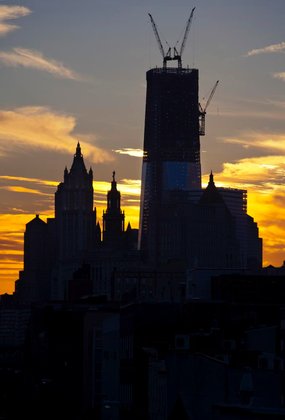
Tower of Power: One World Trade Center Takes Shape

ESTO has unveiled a portfolio of stunning photos documenting the progress of One World Trade Center, the main tower taking shape at the WTC site ("Ground Zero").   

David Sundberg / ESTO
Photographer David Sundberg lives in Lower Manhattan and, over the last few years, the view from his apartment has changed dramatically. He's been watching One World Trade Center fill the 9/11 hole in the sky. Originally called The Freedom Tower, the new building, designed by SOM, is a major addition to the skyline of Lower Manhattan.

SOM's crystalline tower, like the Burj Khalifa and other mega-skyscraper projects, takes some inspiration from Frank Lloyd Wright's audacious design for the Illinois ("Mile High") building, proposed for Chicago.  

Wright's Illinois building
For a virtual tour of the Illinois created for the Guggenheim's Wright retrospective, click here.

Friday, March 30, 2012

(Norman) Foster the People: A Starchitect Visits the Martin House, No Comment on How Much it Weighs...

I was delighted yesterday to have Pritzker Prize winner Norman Foster (Lord Foster of Thames Bank) and his wife, Lady Foster, visit for a tour of the Martin House Complex.  It's not every day that such a "starchitect" comes to Buffalo.  Foster was in town visiting the Albright-Knox Art Gallery, and stopped by to see Wright's opus, accompanied by Pedro Haberbosch (a Partner in Foster + Partners) and UB Architecture professor and Martin House board member Brian Carter.

Baron and Lady Foster at the Martin House

Swiss Re HQ, 30 St. Mary Axe - the "Gherkin"
Of the contemporary starchitects that have become household names - Gehry, Hadid, Libeskind - Foster may be a bit more under the radar.  But his firm has made its mark internationally with a series of stunning projects - from the soaring Millau Viaduct (Millau, France) to the iconic new Reichstag building (Berlin) to the controversial Swiss Re HQ, 30 St. Mary Axe (the "Gherkin") which transformed the London skyline.  Foster + Partners are perhaps best known among Frank Lloyd Wright fans for Fortaleza Hall, the new multi-purpose building on the campus of Wright's Johnson Wax complex in Racine, WI.

Fortaleza Hall at the Johnson Wax complex

Foster's biography is intriguing as well:  born to a working-class Manchester family, his drawing abilities were "discovered" by a Manchester treasury clerk, leading to studies at the University of Manchester School of Architecture and Yale University. He established Foster + Partners in London in 1967, and after building an international reputation over the next two decades, the personal and professional accolades started to accumulate: Foster was knighted in 1990 and appointed to the Order of Merit in 1997. In 1999, he was created a life peer, as Baron Foster of Thames Bank, of Reddish in the County of Greater Manchester, and became the 21st Pritzker Architecture Prize Laureate in the same year.

Foster's wife, Dr. Elena Ochoa Foster (Lady Foster of Thames Bank), is an accomplished Professor of Psychopathology and founder of Ivory Press, a publisher devoted to artist's books.  In 2011, Lady Foster and Ivory Press produced an engrossing documentary on her husband's work, entitled How Much Does Your Building Weigh, Mr. Foster?  The acclaimed film will be screening in major US cities later this year.


Friday, March 23, 2012

Spolia: The Excavated Art Glass Flowers of the Martin Conservatory


It may be hard to fathom that the original Martin pergola, conservatory and carriage house were razed by bulldozers in 1962.  But this small, sculptural fragment from a conservatory art glass window is a surreal reminder and proof positive that three of five original buildings of Frank Lloyd Wright's Martin House complex were torn down, art glass and all.

The fragment is a "blossom" section from one of the conservatory windows or door panels (left) - small squares and chevrons of glass and caming that suggest a flower head.  These were balanced atop a vertical "stem," accented with triangular, abstract "leaves."  It's a curious piece of modern spolia (literally, "spoils"), a term used to describe the Romans' extensive recycling of architectural elements.  The Romans incorporated fragments of previous buildings from throughout the empire (including Egyptian obelisks, Greek columns and sculpture, etc.) into new structures.  In this case, the recycling process is not complete, but there isn't a similarly evocative term for rescued architectural fragments that become museum collection items (at best) or conversation pieces (at least).

Martin House Senior Curator Jack Quinan recovered this art glass fragment from the back-fill of the original conservatory site in 2004, prior to the reconstruction of the building.  He soon came to refer to that heap of dirt as the "spoils" pile, as it yielded several boxes full of original floor tile, various types of glass, brass caming, fragments of Novus glass and the like.  No pieces of the True Cross, but some "holy relics" of original Wright buildings nonetheless.

For more of the strange and gruesome tale of the demolished Martin art glass windows, see "Stranger Than Fiction" and "Picking Up the Pieces," previous posts on the Weekly Wright-up.

Friday, March 16, 2012

Rule Britannica: Frank Lloyd Wright and Darwin Martin Make Their Case; Colbert's Handy Desk Set of Wikipedia; and the Encyclopedia Britannica Goes Digital

 
Darwin D. Martin had a fastidious mind with an appetite for factoids.  Long before one could "Google" such information, Martin relied on his Eleventh edition set of Encyclopedia Britannica.  He was known to take a volume with him for some "light" reading on the way to work, and to quiz family members at dinner, with the encyclopedia providing the definitive answers.  Martin's architect, Frank Lloyd Wright, designed a custom bookcase for his beloved Britannica, including a larger slot at the bottom for the index.  Both the encyclopedia set and stand have returned to the library of the Martin House after years of storage and conservation.

And, as of this week, it seems that Martin's beloved set will be even more of a collector's item:  Britannica announced that it will discontinue its hard-copy editions in favor of all-digital publication.

Devotees of handsome hardcover sets of encyclopedia will cry foul, but Britannica is simply trying to keep up with the online behemoth Wikipedia.   Britannica President Jorge Cauz discussed the publisher's strategy and its competition with NPR's Robert Siegel.


In an inversion of this print-to-digital trend, Stephen Colbert recently played the Luddite by showing off a phonebook-sized volume of his printed version of Wikipedia (Star Trek, Yeoman Rand through Yeoman Smith, B).  

How would Darwin Martin or Frank Lloyd Wright have reacted to the digitization of encyclopedic information?  I don't know - look it up.  


Thursday, March 8, 2012

I Love New York "Crush:" From Niagara Falls to the Martin House

Don't miss this short film from "I [heart] NY," featuring the Martin House Complex and Executive Director Mary Roberts!  Sweet as an Orange Crush...